
New LCP research shows fall in pensioner poverty has ‘gone into reverse’, with single pensioners at highest risk
Pensions & benefits Personal finance Policy & regulation

A major new research paper published today by LCP reveals a sharp increase in poverty amongst pensioners in the last decade, with particularly rapid increases for retirees who are divorced or who never married.
This breakdown of the official poverty figures has never previously been published.
The paper finds that two thirds of single pensioners in poverty are women, and advocates a range of policies for the Government’s Pensions Commission to consider to address these issues.
Key findings include:
- The total number of single pensioners in England and Wales who are divorced has trebled since 2002 – an increase of over 1 million to 1.5m in 2024.
- The number who are ‘single, never married’ has started to rise, now standing at 0.8m, reflecting growing numbers who previously cohabited outside marriage.
- Pensioner poverty reached its lowest point in 2013/14 but has been rising steadily since then; figures previously published by DWP show that, on a consistent basis, overall pensioner poverty rose from 15.7% in 2012/13 to 18.6% in 2023/24.
- Couple pensioners have always had lower poverty rates than singles, but the gap has grown rapidly in the last ten years. As the chart shows, the rise in pensioner poverty since 2012/13 has been driven almost entirely by single pensioners.
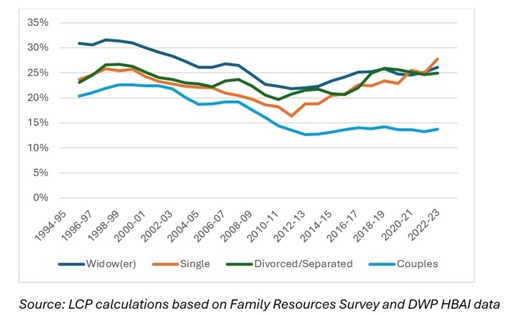
The chart shows:
- Poverty rates for single pensioners are far higher than for couples – nearly double the rate in the latest data.
- Whereas poverty amongst pensioner couples has been relatively flat since 2012/13, it has risen sharply amongst single pensioners; the fastest rise has been in the ‘single, never-married’ group, but also amongst divorced pensioners.
Given that the majority of single pensioners in poverty are women, a range of policies designed to improve women’s independent access to income in retirement would help to stem this increase.
Potential policies set out in the report, for consideration by the Pensions Commission, include:
- Making it easier for the higher earner in a couple to pay into the pension of their lower earning spouse or partner. This is currently possible but only attracts basic rate tax relief, even if the higher earner pays higher rate tax. The paper proposes that the lower earner – typically the woman – should be awarded higher rate tax relief in these cases.
- Looking at pension sharing when a longstanding cohabiting relationship breaks up. At present, there is no formal mechanism for pension sharing in this situation, leaving women in particular at risk of having very low independent incomes in retirement
- Reviewing whether the move to streamlined, ‘no-fault’ divorces in 2022 has had an impact on rates of pension sharing on divorce, which can be complex and slow
- Considering making annuity purchases ‘joint life’ by default, meaning that unless the individual opted out, there would always be an ongoing annuity payment after the policy holder died.
Some of the discussion of the position of pensioners seems to imply that pensioner poverty is largely solved. But, since 2012/13, pensioner poverty has been rising steadily, predominantly amongst single pensioners. Issues such as inadequate pension sharing at the end of a relationship and the continuing gender pension gap mean that women in particular are at higher risk of poverty in old age. But there are things we can do about this problem, including encouraging couples to share their pension wealth more easily. We also need to look at social changes such as the growth in cohabitation and understand what these mean for later life finances. It is vitally important that the Pensions Commission looks in depth at these issues when drawing up its blueprint for the future of pensions.
Steve Webb LCP Partner
With all the turmoil of a divorce it is vital that the often misunderstood long term value of pensions is not overlooked.
Rhys Taylor A barrister from 36 Family, who specialises in pensions and divorce issues
Notes to editors
- DWP has recently recalculated its estimates of pensioner poverty, but these figures are only available on the revised basis for the last four years. To avoid a discontinuity, the LCP paper uses the old data in order to provide a consistent time series back to the mid 1990s. But the latest DWP data for 2024/25 shows, if anything, an even bigger issue of poverty amongst single pensioners.
- The most comprehensive review of finances after divorce is the ‘Fairer Shares’ study by Bristol University. Chapter 7 of the report deals with pension sharing and finds that the system leaves many women at risk of poor outcomes in retirement.
See: Fair shares? Sorting out money and property on divorce - Nuffield Foundation
https://www.nuffieldfoundation.org/project/fair-shares-sorting-out-money-and-property-on-divorce


