LifeAnalytics for insurers, reinsurers and superfunds
LCP’s leading edge proprietary mortality demographic profiler


LifeAnalytics transforms complex mortality data into clear, actionable insights
Established by analysing real-world experience across pension schemes and the wider population, LifeAnalytics can now help you set longevity assumptions with confidence.
Built on robust statistical modelling and rich member characteristics, LifeAnalytics gives you a clearer view of how life expectancies vary across different populations, so you can make better-informed decisions.
What sets LifeAnalytics apart?
- Developed in-house: Generalised Linear Model using most predictive characteristics
- Large dataset: 3.5m years of exposure and 150,000 deaths
- Advanced methods: Strong predictive power validated with out-of-sample testing
- Seamless integration: Hosted within client systems, so no personal data leaves your organisation
LCP LifeAnalytics has been developed over the last 10 years to deliver robust longevity base table assumptions to hundreds of LCP’s clients.
Find out more by speaking to one of our experts
Contact the teamOur experts


Frequently asked questions
-
LifeAnalytics is a self-service mortality modelling tool that helps our clients develop robust, data-driven mortality base table assumptions. It has been calibrated using experience data from members of UK pension schemes to provide clear insight into appropriate longevity assumptions at both member and portfolio level.
-
LifeAnalytics is built using observed mortality experience from pension scheme members alongside data from the England and Wales population.
-
The model analyses how mortality rates vary by key member characteristics, such as age, sex, region, pension size, socio-economic group, a proxy for ill-health retirement, and member status (member or dependant). These characteristics are combined to estimate an appropriate mortality assumption for each individual.
-
LifeAnalytics is delivered as a self-service tool that integrates directly into our client’s own systems. This allows users to run analyses at their own pace, retain full control, and embed the outputs seamlessly into existing workflows.
-
No. LifeAnalytics runs within the client’s own environment, meaning no member data is transferred externally. This removes unnecessary complexity and supports strong data governance and security.
-
LifeAnalytics combines pension scheme experience data with England and Wales population data to create reliable longevity assumptions.
For each person and each calendar year, we know:
- Whether they were receiving a pension over the year;
- Whether they died during the year, or survived; and
- The characteristics that might be indicators of their relative likelihood of them dying. The characteristics we use are age, sex, region, pension amount, a proxy for whether they retired in ill-health, socio-economic group and status (member or dependant).
The predictive weight for each characteristic (i.e. the extent to which it predicts the probability of dying) is derived by fitting a model that “most likely” explains the observed rates of mortality across the whole dataset over each calendar year for each sex and age, given their characteristics.
The form of the model allows for the differences in mortality rates by characteristics to diminish at older ages.
-
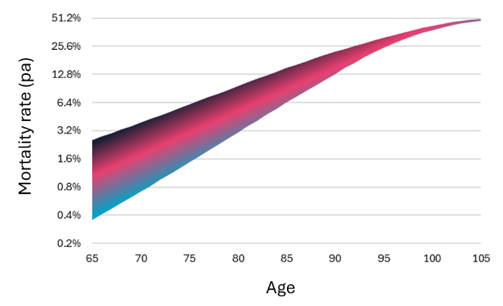
The output of the model is a single curve for each member of the portfolio, taking into account all of the characteristics set out above.
The curves provided are for ages 20 to 120, with a difference of life expectancy at age 65 of 9 years from a higher socio-economic male living in the south of England to a lower socio-economic group male living in Scotland, who retired in ill-health.