Major new research reveals a ‘glimmer of hope’ on tackling gender and ethnicity pension gap
Pensions & benefits DB pensions DC pensions Diversity / DEI


LCP, Independent Governance Group (IGG) and Smart Pension today launch ‘A glimmer of light on the horizon: what women from Britain’s ethnic minority communities have to say about retirement finances’, a new report analysing the gender pension gap, specifically in relation to women from ethnic minority backgrounds.
The Department for Work and Pensions has calculated that the typical woman in her late fifties has private pension wealth only just over half of that of the typical man (£81,000 for women v £156,000 for men). Previous Government and industry reports have demonstrated the significant gender pension gap, in which women have less pension wealth than men of the same age.
At the same time, pension industry research reports have suggested that men and women from Britain’s ethnic minorities also tend to have lower average pension wealth than their White British counterparts.
Taken together, this would suggest that at the intersection of these two groups – women from ethnic minorities – pension disadvantage could be expected to be particularly acute. With Black and Asian females accounting for nearly 1 in 7 of the female population of England and Wales, this is a significant and growing issue.
However, the new jointly commissioned research has uncovered encouraging progress for the pension prospects of these women.
A glimmer of hope
The report is based on more than 12 hours of focus groups, facilitated by Opinium Research, and involving contributions from more than fifty Black and Asian women across a range of ethnic groups and age ranges up and down the country.
The groups discussed a wide range of issues relating to financial planning for later life, and the full report includes extensive verbatim quotes from these women.
Although the research identified major challenges for these groups (see below), there were two positive high-level findings that offer hope for the future.
- The relative disadvantage faced by women from ethnic minorities could be starting to fall. This mainly reflects generational differences, as younger women typically have higher qualification levels, are much more likely to be in paid work (see notes to editors), and aspire to financial independence than previous generations
- Although there is a generally low level of knowledge about pensions and some mistrust, there is also a very considerable hunger for information and explanation. There was clear evidence that, if these women felt they knew and understood better how pensions worked and what they could deliver, they would be more likely to engage.
A very wide range of issues were raised throughout these focus groups, but the more detailed key themes were:
- Signs of a generational shift, with younger women much more likely to be – and expect to be – financially independent, relying much less on other family members, compared with previous generations;
- A relatively low baseline level of knowledge, understanding, and trust around pensions;
- A desire for accessible information about pensions and savings;
- Evidence of a wide range of strategies being used to save for later life, well beyond pensions, including the use of property and other investments;
- Strong hopes and dreams for later life, but anxiety about the ability to attain those goals.
Commenting, Steve Webb, partner at pension consultants LCP, said: “We have become all too used to depressing reports about the pension gap faced by women and by people from ethnic minority communities. But our new research offers a glimmer of hope that things could be changing. We found growing levels of employment, qualifications, and aspirations for financial independence amongst younger Black and Asian women, which are likely to lead to improved pension outcomes. But these women also said that they wanted clearer pensions communication, from trusted sources in plain English and in a place that is easy to find. All of us in the pensions industry need to rise to this challenge.”
Bahea Izmeqna, Chief Product Officer at workplace pension provider Smart Pension, said: “Black and Asian women are making up a bigger proportion of the UK economy than ever before, and that trend is only set to continue. There is a growing need to engage these communities even more closely to ensure their incredibly valuable contribution is properly rewarded in their participation in workplace pension schemes.”
Priti Ruparelia, Head of DC at professional pensions trusteeship provider IGG, said: “While we may have reached a potential turning point for one key facet of the gender pensions gap, there is still a significant challenge ahead. Despite a clear eagerness among women from ethnic minority backgrounds to learn, gaps in knowledge remain.
“It’s clear that our industry needs a more nuanced approach that takes account of cultural and social differences, so we can cut through, build trust and support behavioural change. There is a strong desire for accessible information, and we must capitalise on this by developing new, innovative and thoughtful ways of reaching these communities - a need underscored by this research, which shows a real shift as more women take ownership of their own retirement outlook.”
Explore the report
Click hereNotes to editors
- DWP estimates of the gender pension gap are at: Gender Pensions Gap in Private Pensions: 2020 to 2022 - GOV.UK
- 2021 census data for England Wales shows that there were 30.4m females of all ages, of whom around 4.1m or 13.4% were Black or Asian. This compares with 3.1m out of 28.5m in the previous census, or 10.7% of the population. See: Male and female populations - GOV.UK Ethnicity facts and figures
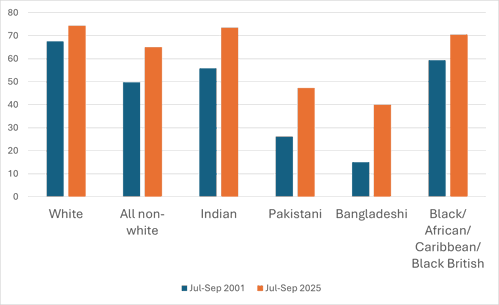
- Chart 1 shows employment rates amongst women aged 16-64 from different ethnic groups in 2001 and in 2025, based on the Labour Force Survey.
Key points are:
- Employment rates for all groups of women have increased, but rates for non-white women have increased faster
- Between 2001 and 2025, the proportion of Indian women in work rose from 56% to 74%, for Pakistani women from 26% to 47%, for Bangladeshi women from 15% to 40%, and for Black African and Caribbean women from 59% to 71%. The equivalent change for white women was from 68% to 74%.
Chart 1. Employment rates (%) for women aged 16-64 by ethnic group